The symbolism of a white dove reaches far beyond the image of a graceful bird with bright feathers and gentle movements. Across centuries, the white dove has represented peace, love, purity, hope, spiritual connection, reconciliation, and new beginnings. Its appearance in religious paintings, wedding ceremonies, peace campaigns, poetry, and popular media demonstrates how a simple natural image can communicate complex human emotions.
White dove symbolism remains influential because it connects something people can observe in nature with ideas that are difficult to express through words alone. A dove flying across an open sky may suggest freedom, while two doves resting together can evoke affection and companionship. In religious art, the same bird may represent divine presence or spiritual renewal.
However, a white dove does not carry exactly the same meaning in every culture or situation. Its interpretation depends on historical traditions, religious beliefs, artistic context, and the experiences of the people viewing it. Understanding these differences makes the symbol more meaningful and helps explain why it continues to appear in both traditional ceremonies and modern visual communication.
What Does a White Dove Symbolize?
White dove symbolism primarily represents peace, purity, love, hope, innocence, and spiritual renewal. In Christianity, the dove is strongly associated with the Holy Spirit, while in weddings it often communicates devotion and harmony. In art and public communication, a white dove can symbolize reconciliation, freedom, and the possibility of a peaceful future.
The exact interpretation depends on the context in which the bird appears.
1. The Core Meanings of White Dove Symbolism
The white dove has several overlapping symbolic meanings. Although peace and purity are among its most recognizable associations, its significance changes according to whether it appears in a religious scene, a personal celebration, a work of art, or a public message.

Peace and reconciliation
A white dove is widely recognized as a symbol of peace. It can communicate an end to conflict, a willingness to forgive, or a desire for people to live together without violence. Its image is especially effective in peace posters, memorial artwork, and humanitarian campaigns.

Love and devotion
Two doves together can represent affection, companionship, fidelity, and emotional connection. This interpretation makes the bird suitable for wedding invitations, anniversary designs, and illustrations celebrating lasting relationships.

Purity and innocence
The association between white feathers and purity comes from broader cultural symbolism surrounding the color white. In this context, the dove can suggest sincerity, gentleness, an untroubled beginning, or an intention free from hostility.

Hope and new beginnings
A dove taking flight can represent the possibility of change after hardship. It may suggest recovery, a fresh start, emotional healing, or optimism about the future.

Spirituality and divine presence
In Christian iconography, the dove has a particularly important religious meaning associated with the Holy Spirit. In other settings, people may interpret a dove as an image of spiritual peace, transcendence, or a connection with something greater than themselves.
These meanings are related, but they are not interchangeable. A dove in a peace mural does not necessarily express the same message as one in a baptismal painting or a wedding illustration.
2. The Historical Origins of White Dove Symbolism
White dove symbolism developed through several historical traditions rather than originating from one universal source. Ancient Mediterranean religion, biblical narratives, classical mythology, and later European art all contributed to the bird’s rich symbolic identity.
Ancient civilizations and the dove
Doves and pigeons have lived alongside human communities for thousands of years. Their presence in settlements, their recognizable calls, and their patterns of pairing made them familiar subjects in ancient stories and religious imagery.
In the ancient Near East and Mediterranean world, doves were associated with certain goddesses, including figures connected with love and fertility. Their association with affection and reproduction helped establish a symbolic relationship between doves, tenderness, and relationships.
In ancient Greek tradition, doves were associated with Aphrodite, the goddess of love and beauty. This connection influenced artistic representations in which doves suggested romance, attraction, and the natural world.
It is important to distinguish these historical associations from the modern image of a white dove as a universal peace emblem. Ancient people used birds in different religious and cultural systems, and the meaning of a dove depended on the deity, ritual, or story involved.
The biblical story of Noah
One of the most influential foundations of dove symbolism appears in the biblical account of Noah and the flood.
In Genesis 8, Noah sends out a dove to discover whether the floodwaters have receded. The dove eventually returns with a freshly plucked olive leaf, indicating that vegetation has become visible again.
This episode connects the dove with several powerful ideas:
- Renewal: Life is returning after a period of destruction.
- Hope: Evidence of a habitable world is beginning to appear.
- Relief: The devastating flood is moving toward its conclusion.
- Restoration: The possibility of life continuing becomes visible.
The olive leaf is especially important because it supplies the dove with a specific message. The bird is not simply a beautiful creature; it becomes a sign that the world is becoming habitable again.
The biblical account does not explicitly describe this dove as white. The familiar white dove used in modern religious and peace imagery is partly the result of later artistic convention.
From religious imagery to a modern peace emblem
Over time, Christian art made the dove an enduring symbol of spiritual presence and peace. Later, the white dove became prominent in secular peace imagery as well.
The twentieth century strengthened this association. In particular, Pablo Picasso’s dove lithograph, created for the 1949 Paris Peace Congress, became an influential image in international peace campaigns. The design helped popularize the dove as a visual emblem of peace after the devastation of the Second World War.
The image was effective because it could communicate a complex political and humanitarian message without requiring the viewer to understand a particular language.
Thus, the history of white dove symbolism illustrates how a symbol can move between religious narratives, artistic traditions, and international public communication.
3. White Dove Symbolism in Christianity and the Bible
In Christianity, the dove has a central place in biblical interpretation and religious iconography. It is especially associated with the Holy Spirit, baptism, divine presence, and peace.
The Holy Spirit and the baptism of Jesus
The New Testament accounts of Jesus’ baptism describe the Spirit of God descending like a dove. The image appears in the Gospels of Matthew, Mark, and Luke, with a related account in John.
Christian artists have frequently represented this moment with a white dove descending from heaven toward Jesus. The image communicates divine presence and spiritual significance through a recognizable visual form.
In Christian symbolism, the dove may therefore represent:
- The Holy Spirit.
- Divine guidance and presence.
- Spiritual renewal.
- Peace between God and humanity.
- The beginning of a significant spiritual mission.
The phrase “like a dove” is important when interpreting the biblical imagery: the text uses the dove as a comparison for the Spirit’s descent. The familiar artistic depiction of the Spirit as a white dove became an established Christian convention.
Baptism, confirmation, and religious art
Doves appear in Christian churches, baptismal decorations, stained-glass windows, and religious paintings. In these contexts, the bird may communicate spiritual transformation, the presence of the Holy Spirit, or the beginning of a renewed life of faith.
For example, a baptismal invitation featuring a dove and gentle rays of light may visually reinforce themes of blessing and spiritual beginnings.
A dove on a church window can serve a similar function, allowing viewers to recognize a religious idea without reading an accompanying explanation.
Does the Bible say that a white dove always represents peace?
No. The Bible contains different bird images and uses them in different contexts. The dove is particularly important in the accounts of Noah and Jesus’ baptism, but its meaning must be interpreted from the specific passage rather than assumed to be identical everywhere.
Expert insight: When writing about Christian dove symbolism, distinguish the biblical narrative, the theological interpretation, and the artistic convention. This makes the explanation more accurate and avoids treating every later image as a direct biblical statement.
4. White Dove Symbolism Across Cultures and Belief Systems
Although the white dove is widely associated with peace, its symbolic meaning is not identical across every culture. Religious histories, local traditions, and artistic practices influence how people understand the bird.
| Cultural or interpretive context | Common association | Important distinction |
| Christianity | Holy Spirit, divine presence, renewal | Especially connected with biblical accounts of the Spirit’s descent |
| Ancient Greek tradition | Love, beauty, and associations with Aphrodite | The meaning belongs to a particular mythological and religious setting |
| Biblical flood narrative | Hope and the return of habitable conditions | The olive leaf is a key part of the message |
| Modern international peace imagery | Peace, reconciliation, antiwar sentiment | The symbol developed through modern art and public campaigns |
| Weddings and celebrations | Love, harmony, and new beginnings | Meaning depends on the ceremony and the people involved |
| Contemporary spiritual interpretation | Inner peace, hope, or spiritual connection | Personal beliefs differ and are not universal historical facts |
Western cultural traditions
In many European and North American contexts, the white dove is familiar from church art, peace demonstrations, wedding imagery, and memorial ceremonies.
Its symbolism often draws on overlapping Christian, classical, and modern cultural influences. As a result, people may recognize the bird as a symbol of peace even when they do not identify with a particular religion.
South Asian cultural contexts
In South Asia, the dove can be understood through several overlapping influences, including international peace imagery, religious art, literature, and contemporary media. However, there is no single South Asian interpretation that applies to every community.
In Pakistan and neighboring regions, for example, a white dove used in a peace poster may communicate harmony and goodwill through widely recognized international visual conventions. In a Christian religious setting, it may carry a more specific connection to the Holy Spirit.
The intended audience and surrounding imagery determine which interpretation is most likely.
Islamic perspectives and cultural distinctions
A white dove should not automatically be presented as a specifically Islamic religious symbol. Although birds feature in Islamic scripture, literature, and cultural traditions, the modern white dove as an emblem of peace has a broader and more varied history.
Muslim audiences may recognize the dove as a general symbol of peace, especially in contemporary visual communication, without assigning it a prescribed Islamic theological meaning.
This distinction matters when designing religious posters, educational resources, or culturally sensitive artwork. A general symbol of peace can be meaningful without being attributed to a religious tradition that does not specifically establish that interpretation.
Why cultural context matters
Symbols work through shared knowledge. A viewer who grew up seeing doves in church paintings may immediately think of the Holy Spirit, while someone encountering a dove on an antiwar poster may think of diplomacy and reconciliation.
Neither interpretation is necessarily wrong. Each is shaped by a different context.
The most reliable approach is to describe well-documented historical associations clearly while presenting personal or contemporary interpretations as possibilities rather than universal beliefs.
5. The Psychological Meaning of a White Dove
The psychological appeal of the white dove comes partly from the way people interpret familiar natural forms, colors, and movements. Its symbolic power is not evidence that every person experiences the bird in the same way; rather, it reflects a combination of cultural learning, visual associations, and personal experience.
Why does a dove communicate peace?
A dove can communicate peace because people repeatedly encounter it in images, stories, ceremonies, and public messages where peaceful intentions are emphasized.
This is an example of learned symbolic association. When an image is used consistently in a particular context, audiences can learn to recognize the idea it represents.
The dove’s gentle appearance may also support its association with calmness. Yet the symbolism does not arise from appearance alone. Historical narratives and repeated use in art and media are equally important.
The psychology of white
White has different meanings across cultures, but it is frequently associated in Western visual conventions with cleanliness, simplicity, light, and purity. When a white dove appears against a darker background, the contrast can make the bird appear especially noticeable and visually distinct.
The combination of white feathers and a recognizable bird silhouette reinforces the symbolic message.
Consider these two examples:
- A white dove against a pale blue sky can suggest openness, freedom, and tranquility.
- A white dove emerging from a dark, stormy background can suggest hope after suffering or conflict.
The bird remains the same, but the composition changes the emotional interpretation.
Personal memories and emotional associations
A person who has seen doves at a meaningful family gathering may connect them with belonging or affection. Another person may associate a dove with a memorial service or religious experience.
These responses illustrate how symbolism interacts with autobiographical memory. The meaning of an image is partly cultural and partly personal.
However, a white dove should not be treated as a scientifically established sign of someone’s emotional state, future events, or spiritual condition.
6. White Dove Symbolism in Spirituality
In contemporary spiritual language, white doves are often associated with inner peace, hope, spiritual growth, forgiveness, and a sense of connection beyond everyday concerns.
These interpretations may be meaningful to individuals, but they vary across spiritual traditions and should not be presented as scientifically proven facts.
Inner peace and emotional renewal
A dove resting quietly or flying freely may serve as a visual reminder to seek calmness, release resentment, or approach a difficult situation with patience.
For example, someone creating a personal journal cover might choose a white dove to represent a period of growth after a challenging experience.
In this situation, the symbol functions as a personal expression of intention rather than evidence of an external spiritual message.
Is seeing a white dove a spiritual sign?
Some people interpret an unexpected encounter with a white dove as a reminder of hope, comfort, or spiritual connection. Others see it as an ordinary encounter with a bird.
Neither interpretation can be established from the sighting alone. There is no reliable scientific basis for claiming that every white dove sighting predicts a particular event or carries a universally defined supernatural message.
A balanced interpretation allows room for personal meaning without turning belief into fact.
White doves and remembrance
In some memorial settings, a dove may represent peace, remembrance, or the wish that a person who has died be remembered with love.
Its use can provide a gentle visual language for grief, especially when words are difficult to find. However, the symbolism does not replace the diverse religious and cultural beliefs people hold about death and the afterlife.
7. White Dove Symbolism in Art and Iconography
Artists use white doves because their familiar shape and established associations allow them to communicate meaning quickly. Through composition, movement, scale, and contrast, the bird can become a central element in a visual narrative.
The dove as a visual metaphor
A visual metaphor uses an image to communicate an idea beyond its literal subject. A dove carrying an olive branch, for example, can represent reconciliation rather than simply depict a bird carrying vegetation.
Different artistic choices create different meanings:
- Wings spread wide: freedom, openness, or an appeal for peace.
- A dove holding an olive branch: reconciliation, hope, or the end of hostility.
- A dove descending through rays of light: divine presence in Christian art.
- Two doves facing each other: affection, harmony, or partnership.
- A dove rising from darkness: renewal after hardship.
These interpretations are conventions rather than rigid rules. Artists can deliberately challenge familiar meanings by placing a dove in an unexpected setting.
Color, composition, and negative space
In graphic design, white feathers can contrast effectively with dark blue, black, or muted backgrounds. This helps the bird remain visible while supporting a calm or reflective mood.
Negative space—the area surrounding the main subject—can also contribute to the meaning. A small dove in a large open sky may emphasize freedom, solitude, or the possibility of peace.
For a professional poster, a designer might place a white dove near the upper center, use a restrained palette, and keep the headline short. The image then communicates the theme without competing with the text.
Dove symbolism in religious iconography
In Christian paintings, the dove is often positioned above or near a central religious figure. Its placement helps viewers understand the relationship between the visible scene and its spiritual interpretation.
In secular artwork, the bird may instead appear above a crowd, across a border, or against a landscape affected by conflict. These choices shift the emphasis toward collective hope, peace, and reconciliation.
8. White Dove Symbolism in Literature and Storytelling
In literature, the white dove can communicate a theme without requiring a lengthy explanation. Writers may use it as a recurring image, a symbolic turning point, or a contrast with a troubled environment.
Hope after hardship
A dove appearing after a storm, battle, or period of uncertainty may signal a change in the emotional direction of a story.
For example, a fictional village might spend years divided by conflict. When the characters finally negotiate a truce, the author could describe a dove settling on the village gate. The bird would reinforce the theme of reconciliation without needing to explain the meaning directly.
This is an illustrative example, not a quotation from a published work.
Innocence and vulnerability
Because the dove is commonly associated with gentleness, writers may use it to represent innocence or vulnerability. A fragile dove in a violent setting can make the surrounding conflict appear more troubling.
The contrast can be powerful, but it also creates opportunities for more complex storytelling. An author might deliberately challenge the expectation that a gentle-looking creature represents uncomplicated goodness.
How writers can use dove symbolism effectively
The strongest symbolic writing allows an image to develop naturally from the story.
A writer can introduce a dove early as a sign of hope, return to it during a period of conflict, and use its final appearance to suggest reconciliation. The meaning becomes more powerful because readers have watched it develop.
Repeatedly stating that the dove means peace would be less effective than allowing its appearances to carry emotional significance.
9. White Dove Symbolism in Branding, Marketing, and Design
The white dove is useful in visual communication because it is recognizable, relatively easy to illustrate, and associated with several positive concepts. However, its effectiveness depends on whether the symbol matches the organization’s message.
Branding and visual identity
A charity focused on peacebuilding, reconciliation, humanitarian support, or community cooperation might use a dove to communicate its purpose.
For example, a peace-focused nonprofit could pair a simple dove silhouette with a restrained typeface and a short mission statement. The symbol would help audiences identify the theme before reading the full message.
By contrast, a technology company specializing in data security might find the dove too indirect unless it deliberately wants to emphasize trust, safety, or social responsibility.
Consumer perception and design choices
A familiar symbol can make a message easier to recognize, but it cannot guarantee that consumers will trust a brand or support its mission.
The surrounding design matters. A crowded layout, unclear wording, or misleading claims can undermine the intended message regardless of how recognizable the dove may be.
Good design should make the relationship between the symbol and the organization’s purpose clear.
Practical applications
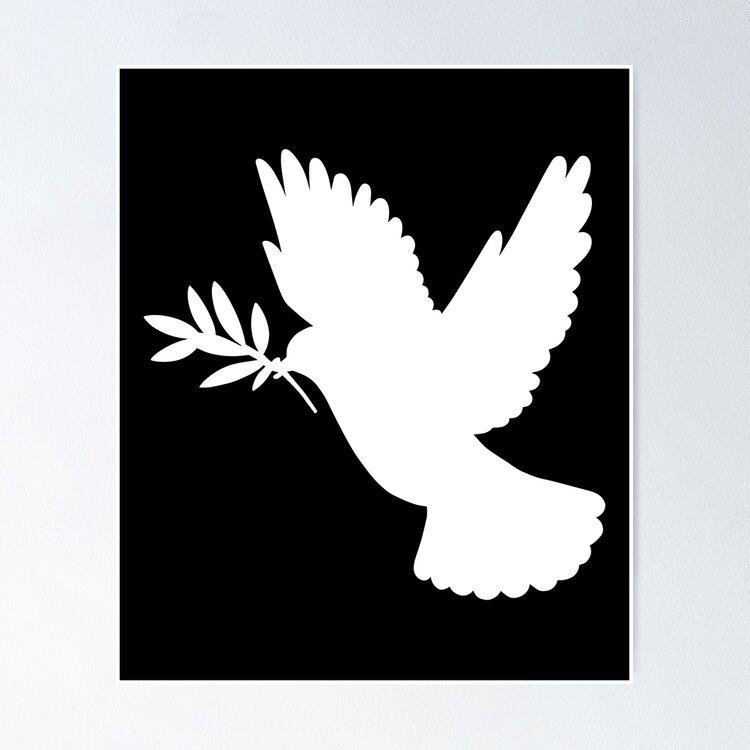
Peace awareness posters
Use a clearly recognizable dove with an olive branch, a concise headline, and enough negative space to keep the message legible.
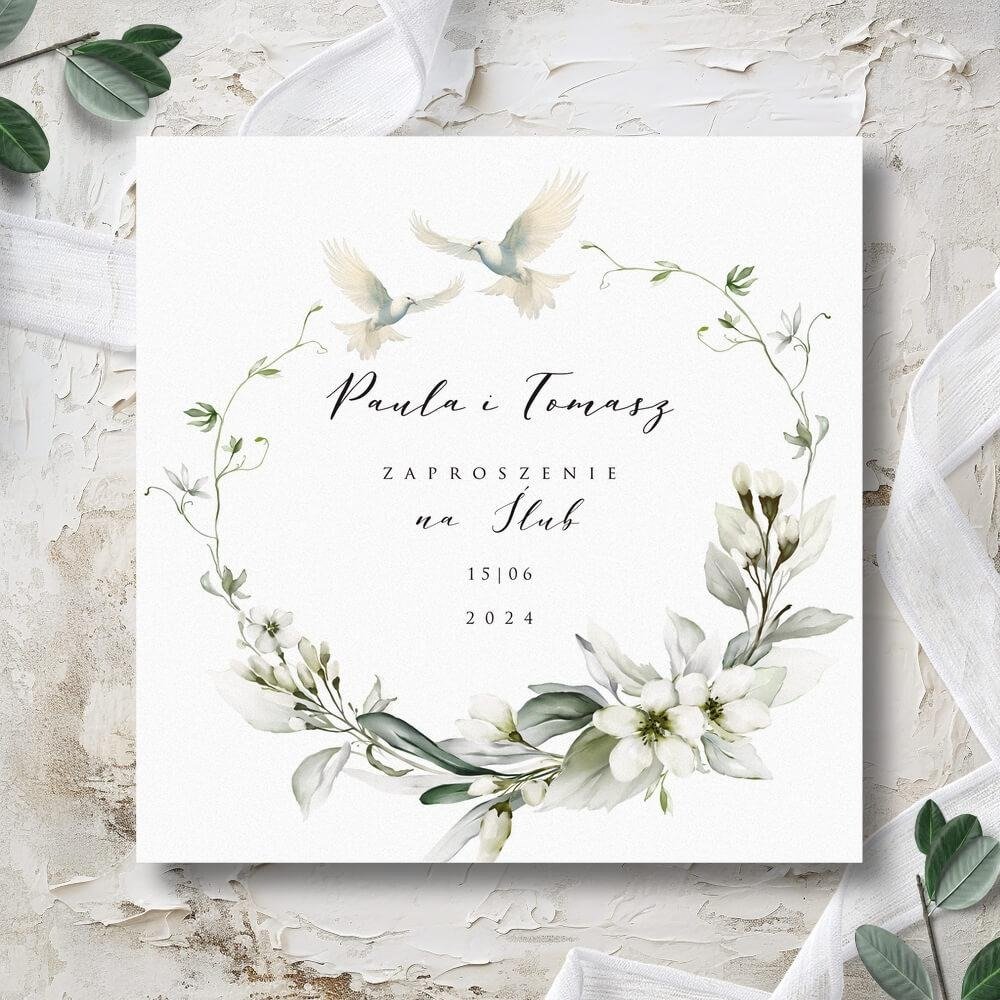
Wedding invitations
Pair two doves or a subtle dove motif with refined typography to suggest affection, harmony, and a shared future.

Christian religious materials
Use the dove alongside appropriate religious wording when the intention is to communicate the Holy Spirit, baptism, or spiritual renewal.
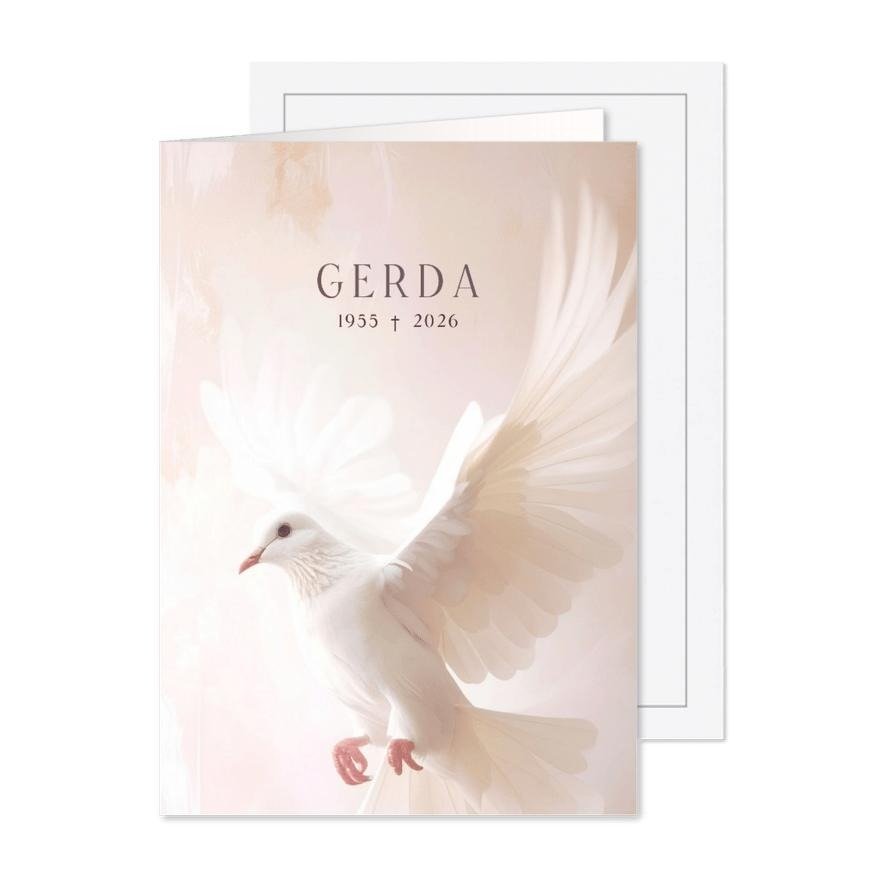
Memorial cards
A small dove can convey remembrance and peace without making the design visually overwhelming.
Expert tip: Decide on the message before choosing the artwork. A dove with an olive branch is particularly suitable for reconciliation, while a dove descending through light may be more appropriate for Christian religious imagery. Clear intent makes the design more effective.
10. White Dove Symbolism in Modern Media and Digital Communication
Today, dove imagery appears in social media graphics, educational materials, online campaigns, illustrations, animations, and digital greeting cards.
Its continued usefulness reflects the importance of recognizable visual symbols in communication across languages.
Social media and emojis
The dove emoji, 🕊️, is often used to communicate peace, remembrance, hope, or a desire for harmony. Its meaning depends on the accompanying text and the context of the conversation.
For example:
- A peace campaign may use it to express opposition to violence.
- A memorial post may use it to convey remembrance.
- A message about resolving an argument may use it to suggest reconciliation.
- A spiritual reflection may use it to express hope or faith.
The emoji does not have one fixed interpretation in every conversation. The writer’s intention and the reader’s cultural background influence its meaning.
Film and animation
In films, a dove may appear during a turning point to suggest that a conflict is ending or that a character is beginning a new chapter.
Animation can strengthen this effect through movement. A dove taking flight can visually mark a transition from confinement to freedom, while a stationary bird may suggest calmness or fragile stability.
These effects depend on the surrounding narrative. A dove placed in a threatening scene could even create irony by contrasting the idea of peace with the reality of danger.
Education and visual literacy
Teaching dove symbolism offers a practical way to introduce students to semiotics, the study of signs and meaning.
Students can compare a dove in a biblical illustration, a peace poster, and a wedding invitation. Although the central image remains similar, each example uses the bird to communicate a different message.
This exercise demonstrates that symbols are not isolated objects with automatic meanings. They work within systems of culture, history, language, and visual design.
11. White Dove Symbolism: Common Misconceptions
Several common assumptions oversimplify the meaning and history of the white dove.
| Misconception | More accurate interpretation |
| Every white dove symbolizes peace. | Peace is a widespread association, but context can change the meaning. |
| The Bible says Noah’s dove was white. | Genesis describes the dove and its olive leaf but does not specify its feather color. |
| A white dove always represents the Holy Spirit. | This is an important Christian association, not a universal meaning across all contexts. |
| Seeing a white dove predicts good news. | Some people interpret encounters spiritually, but such predictions are not scientifically established. |
| The dove has always been a universal peace symbol. | Its meaning developed through different traditions and became especially prominent in modern peace imagery. |
| The color white means purity in every culture. | Color associations vary according to cultural practices, religious traditions, and social context. |
Myth vs. fact
Myth: A white dove has the same meaning everywhere.
Fact: Its meanings overlap, but they are shaped by history, religion, local culture, and the circumstances in which the image appears.
Myth: A dove’s symbolic meaning is determined entirely by its color.
Fact: The bird, its actions, accompanying objects, composition, and cultural setting all contribute to its interpretation.
Myth: Symbolic interpretations are scientific predictions.
Fact: Symbolism is a cultural and interpretive practice. A meaningful image can provide comfort or communicate an idea without proving a supernatural claim.
12. How to Interpret a White Dove in a Specific Context
When you encounter a white dove in a painting, dream narrative, ceremony, book, or digital image, begin with the context rather than assigning it a fixed meaning.
Use these questions to guide your interpretation:
- Where does the dove appear? A church, wedding, peace rally, and fictional battlefield each provide different clues.
- What is the bird doing? Flying, resting, descending, or carrying an olive branch can influence the message.
- Which other symbols appear nearby? Light, water, flowers, a cross, or an olive branch may narrow the interpretation.
- Who created the image, and for whom? The artist’s intention and the intended audience can explain the chosen symbolism.
- What cultural or personal associations might influence the viewer? Different viewers may recognize different layers of meaning.
If a white dove appears in a dream, for example, you can reflect on whether it connects with feelings of hope, freedom, peace, or a recent personal experience. There is no universally validated dream dictionary that can establish one definite meaning for every person.
This approach combines historical understanding with interpretive flexibility and avoids presenting speculation as certainty.
13. Did You Know? Five Interesting Facts About White Dove Symbolism
- The dove in Noah’s story carries an olive leaf. This detail connects the bird with the return of vegetation and the possibility of life after the flood.
- The dove is important in Christian iconography. It is a familiar artistic representation of the Holy Spirit, particularly in depictions of Jesus’ baptism.
- Pablo Picasso helped popularize modern peace imagery. His dove lithograph was associated with the 1949 Paris Peace Congress.
- A dove’s color is not the only source of its meaning. Its symbolic significance also depends on religious narratives, historical traditions, and the objects or scenes surrounding it.
- A symbol can cross language barriers. A recognizable dove illustration can communicate a message of peace to audiences who speak different languages, even though its precise interpretation may vary.
14. Key Insights: What Makes the White Dove Such a Powerful Symbol?
The white dove’s significance comes from the interaction of natural imagery, cultural memory, religious traditions, and visual communication.
Its most important symbolic associations include:
- Peace: the desire to end conflict and establish harmony.
- Love: affection, companionship, and devotion.
- Purity: sincerity, innocence, and the color-based conventions surrounding white.
- Hope: the possibility of improvement after difficulty.
- Spirituality: divine presence in Christian tradition and personal spiritual reflection in other contexts.
- Renewal: the beginning of a new phase or the restoration of what was lost.
- Freedom: the possibility of movement, release, and a life beyond limitations.
The most useful insight is that these meanings are related without being identical. An artist, writer, teacher, or designer can choose the interpretation that best fits a particular message while remaining aware of the symbol’s wider cultural history.
Frequently Asked Questions About White Dove Symbolism
1. What does a white dove symbolize spiritually?
A white dove may symbolize spiritual peace, hope, renewal, purity, or a sense of connection with something greater than oneself. In Christianity, it is particularly associated with the Holy Spirit. Other spiritual interpretations vary according to personal beliefs and cultural traditions, so there is no single meaning that applies to everyone.
2. What does a white dove symbolize in Christianity?
In Christianity, the dove is strongly associated with the Holy Spirit, especially in accounts of Jesus’ baptism. It can also represent spiritual renewal, divine presence, and peace. Christian artwork frequently depicts a white dove descending from above to communicate these theological ideas.
3. Why is a white dove a symbol of peace?
The dove became associated with peace through a combination of historical religious imagery, cultural traditions, and modern public communication. Its connection with the biblical flood narrative contributes associations with hope and restoration, while twentieth-century peace campaigns helped establish the dove as a recognizable international emblem of peaceful intentions.
4. What does a white dove with an olive branch mean?
A white dove carrying an olive branch commonly symbolizes peace, reconciliation, and hope after conflict. The image draws particular significance from Genesis 8, where Noah’s dove returns with a freshly plucked olive leaf, indicating that vegetation has appeared after the flood.
5. What does seeing a white dove mean?
Seeing a white dove may remind someone of peace, love, hope, or a personal spiritual belief. The interpretation depends on the person’s experiences and cultural background. Some people attach spiritual significance to such encounters, but there is no scientific evidence that seeing a white dove universally predicts a particular event.
6. What does a white dove symbolize at a wedding or memorial?
At a wedding, a white dove commonly represents love, harmony, commitment, and new beginnings. At a memorial, it may represent remembrance, peace, or the wish to honor someone who has died. The exact meaning depends on the ceremony, the people involved, and their cultural or religious traditions.
Conclusion: The Enduring Meaning of White Dove Symbolism
White dove symbolism continues to matter because it gives visible form to ideas that people across different communities seek to express: peace, love, hope, purity, reconciliation, and renewal.
Its history connects ancient Mediterranean traditions, the biblical account of Noah, Christian representations of the Holy Spirit, classical mythology, and modern international peace campaigns. Each historical setting contributes a different layer of meaning rather than a single universal definition.
In art and literature, the dove can represent a turning point, an emotional contrast, or the possibility of healing. In branding and graphic design, it can communicate peace and goodwill through a recognizable image. In religious settings, it can express specific theological ideas, while in personal and digital communication it may serve as a reminder of hope or harmony.
Understanding the symbol requires attention to context. The bird’s color, movement, surrounding imagery, cultural background, and intended audience all influence its interpretation.
Ultimately, the white dove remains powerful not because every person understands it identically, but because its established associations make it a flexible and memorable way to communicate meaningful human ideas.

